
Thermal Monitoring of Electrical Switchboards Using a Silicone-Assisted Hetero-Core Optical Fiber Sensor
 ; Hyoung-Jin Kim**
; Yong-Woon Kitani***
; Yoshinobu Hagiwara****
; Young-Bok Kim*****, †
; Hyoung-Jin Kim**
; Yong-Woon Kitani***
; Yoshinobu Hagiwara****
; Young-Bok Kim*****, †
Abstract
This This study investigates the development of a hetero-core optical fiber temperature sensor for early fire detection in electrical switchboards. The proposed sensor utilizes the thermal expansion of silicone materials to generate optical loss variation induced by thermally produced strain. Silicone pads with identical length (50 mm) and width (10 mm), and thicknesses of 2 mm and 5 mm, were fabricated and tested. The hetero-core optical fiber was attached along the longitudinal direction of the specimen, and optical loss variation was converted into voltage signals using an optical amplifier. Experimental results demonstrated that temperature changes could be effectively detected through material expansion. However, nonlinear response and poor repeatability were observed due to the viscoelastic behavior of silicone and bonding interface effects. These results provide a basis for improving hetero-core optical fiber temperature sensors for switchboard fire monitoring applications.
Keywords:
Switchboard, Fire Accident, Monitoring System, Optical Fiber Sensor, Sensing System1. Introduction
Temperature sensing technologies are essential in various industrial and engineering applications, particularly in electrical facilities where accurate and reliable monitoring is required under harsh environmental conditions.
In electrical switchboards and high-current power systems, abnormal temperature rise caused by contact resistance, overload conditions, or poor electrical connections is one of the major causes of fire accidents and reliability degradation.1-4) Therefore, continuous thermal monitoring is critically important for ensuring the operational safety and reliability of electrical power systems.1-3) Recent studies have emphasized the importance of thermal monitoring and predictive maintenance technologies for early detection of overheating faults in industrial electrical facilities.2,3)
Optical fiber-based sensors have attracted considerable attention for such applications because of their inherent advantages, including immunity to electromagnetic interference, high sensitivity, electrical insulation capability, and suitability for remote sensing.4) In addition, fiber-optic sensing technologies have recently been investigated for thermal condition monitoring and fire detection systems in electrical switchboards.5)
Most conventional optical fiber temperature sensors rely on indirect sensing mechanisms such as structural bending, deformation, or external transducers to convert thermal variations into measurable optical signals. Previous studies on optical fiber sensors have mainly focused on bending-loss and intensity-modulated sensing structures using macro-bending fibers, U-shaped fibers, flexible polymer waveguides, and twin-core fiber configurations.7-13) Although these approaches have demonstrated practical effectiveness, they generally require additional mechanical structures or indirect deformation mechanisms, which may limit sensing reliability and structural simplicity in compact electrical systems such as switchboards.
In contrast, direct utilization of material properties, such as thermal expansion, offers a simpler and potentially more efficient sensing approach. Silicone materials exhibit relatively large thermal expansion coefficients, excellent flexibility, and stable elastic behavior over a wide temperature range, making them suitable candidates for temperature-responsive sensing elements. Previous studies have also reported that silicone rubber provides effective thermal stress relaxation and stable deformability under thermal cycling conditions.14,15) Although viscoelastic effects such as creep, hysteresis, and material degradation may influence long-term repeatability,6,16) the relatively large thermally induced deformation characteristics of silicone make it advantageous for thermal sensing applications.
Despite these advantages, the feasibility of directly converting thermally induced expansion of polymer materials into optical signals has not been sufficiently investigated. In particular, previous bending-based optical fiber sensors differ fundamentally from the proposed sensing mechanism because the present study directly transfers thermally induced axial expansion of silicone materials to a hetero-core optical fiber sensor without relying on conventional bending structures.
Therefore, this study investigates the development of a fiber-optic thermal monitoring module for early fire detection in electrical switchboards using silicone thermal expansion characteristics. The proposed method utilizes thermally induced expansion of silicone pads to generate strain in a hetero-core optical fiber sensor, thereby converting temperature variation into optical loss variation. The objective of this study is to investigate the relationship between temperature variation and optical response, and to evaluate the sensing characteristics of the proposed system in terms of sensitivity, linearity, and repeatability.
2. Principle of Temperature Sensing Based on Thermal Expansion
In this study, temperature sensing is achieved by directly utilizing the thermal expansion behavior of silicone and converting the resulting mechanical strain into optical loss variation using a hetero-core optical fiber sensor. Unlike conventional bending-based sensing mechanisms, the proposed method relies on thermally induced axial strain.
2.1 Thermal Expansion of Silicone
When a material is subjected to a temperature change, it undergoes dimensional variation due to thermal expansion. For a homogeneous material such as silicone, the linear thermal expansion can be expressed as:
| (1) |
- where
- ΔL : change in length,
- α : coefficient of thermal expansion (CTE),
- L : initial length of the material, and
- ΔT : temperature variation.
The corresponding axial strain is defined as:
| (2) |
This relationship indicates that the strain induced in the silicone specimen is directly proportional to the temperature change. Therefore, if this strain can be effectively transferred to a sensing element, temperature can be measured indirectly through strain detection.
2.2 Optical Response Mechanism of Hetero-Core Fiber
The hetero-core optical fiber sensor used in this study consists of two optical fibers with different core diameters spliced together. Due to this structural mismatch, a portion of the optical signal propagating through the fiber is inherently lost at the hetero-core region.
When mechanical strain is applied to the sensing region, the geometry of the optical fiber changes slightly, resulting in additional optical loss. (see Fig. 1 and Fig. 2) In particular, axial strain modifies the propagation conditions within the core, causing a variation in optical transmission.
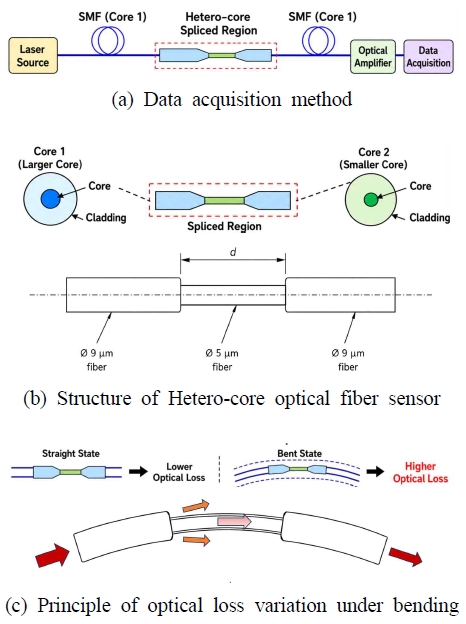
Hetero-core optical fiber sensing technique based on optical loss variation induced by bending
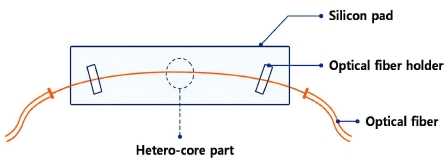
Installation method of the optical fiber sensor on the silicone pad
The change in optical power can be expressed as:
| (3) |
where ΔP is the variation in optical power and ϵ is the applied strain.
The optical signal is then converted into an electrical signal using an optical amplifier, resulting in an output voltage(Vo) proportional to the optical loss:
| (4) |
2.3 Temperature-to-Voltage Conversion Mechanism
Based on the above relationships, the overall sensing mechanism of the proposed system can be summarized as follows:
| (5) |
That is, a temperature change induces thermal expansion in the silicone material, which generates axial strain. This strain is transferred to the hetero-core optical fiber, resulting in a change in optical loss. The optical loss variation is then converted into a measurable voltage signal.
The hetero-core optical fiber sensor shown in Fig. 1 was installed on the silicone pad holder using an adhesive, as illustrated in Fig. 2, in order to measure temperature variation. This configuration can be regarded as the most fundamental structure of a temperature sensing system, as it utilizes the linear deformation characteristics of the silicone pad induced by temperature changes.
The physical properties of the silicone rubber used in this study are summarized in Table 1. Owing to its excellent thermal stability, flexibility, electrical insulation, and weather resistance over a wide temperature range, silicone rubber is an attractive material for temperature sensing applications. It maintains elastic properties even under elevated temperatures and demonstrates relatively large thermal expansion characteristics compared to metallic materials.

Representative physical properties a silicon rubber pad
2.4 Key Characteristics of the Proposed Mechanism
The proposed sensing method has several distinctive features4):
(1) It utilizes intrinsic material properties (thermal expansion) rather than structural deformation.
(2) The sensing mechanism is simple and does not require complex mechanical structures.
(3) The sensitivity depends on the thermal expansion coefficient of the material and the strain transfer efficiency.
(4) Nonlinear behavior may arise due to the viscoelastic properties of silicone and imperfect strain transfer at the bonding interface.
3. Experimental results and discussion
3.1 Experimental preparation
To measure temperature variation caused by heat generation, the optical fiber sensor was attached and fixed onto the silicone pad using an adhesive, as shown in Fig. 2. Three silicone pads with different dimensions and shapes were prepared, and hetero-core optical fiber sensors capable of detecting minute elongation and expansion of the pads were installed on each specimen. The hetero-core optical fiber sensor has the structure illustrated in Fig. 1, and its sensitivity varies depending on the insertion length of the 5 μm optical fiber between the different core diameters.
The linear characteristics of hetero-core optical fiber sensors have already been well demonstrated through various previous studies.
Fig. 3 shows the variation in optical loss according to length change (0-2 mm) when the optical fiber sensor was fabricated in the configuration shown in Fig. 2.
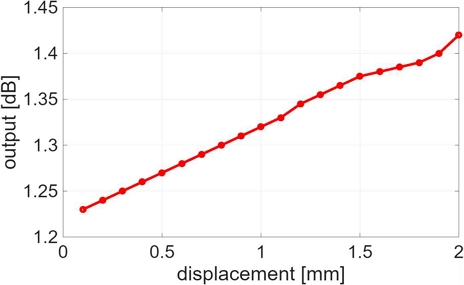
Optical loss variation characteristics of the Hetero-core optical fiber sensor under length change
It can be confirmed that the sensor generally maintains linear characteristics over the measurement range. Therefore, if the length variation characteristics of the silicone pad induced by temperature change are linear, the proposed structure can be effectively utilized as an optical fiber temperature sensor.17,18)
Accordingly, in this study, various sensing units were prepared as summarized in Table 2 by varying the dimensions of the silicone pads and the core diameter configurations of the sensing region. Fig. 4 shows photographs of the fabricated silicone pad specimens for the experiments (left) and the temperature sensor samples with the optical fiber sensor attached to the silicone pads (right).
Specifications and characteristics of the fabricated sensing unit for experimental evaluation
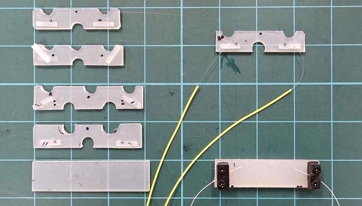
Photo of the silicone pad samples and of the sensor with the optical fiber sensor attached to the silicone pad
3.2 Experimental apparatus
The silicone pads were designed in a rectangular flat shape to ensure sufficient response to temperature variation. Since the primary application of the proposed sensor is fire monitoring in electrical switchboards, the specimens were fabricated in an attachable configuration suitable for surface installation.
To experimentally evaluate the temperature sensing performance, thermal energy had to be uniformly transferred to the sensing region.
Therefore, as shown in Fig. 5, a double-layer stainless-steel plate structure was installed above the heater. The lower tray was filled with water, and the fabricated optical fiber sensor specimens were placed on the upper tray. When the water was heated by the heater, the thermal energy was uniformly transferred to the upper tray and the sensor specimens.
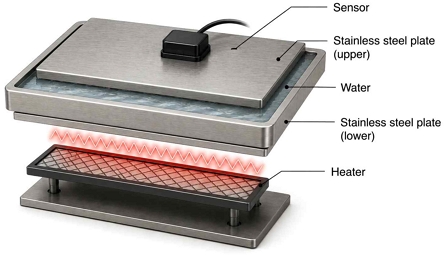
Schematic illustration of the experimental setup for thermal sensing measurements
Fig. 6 shows the actual experimental setup based on the configuration illustrated in Fig. 5. The temperature of the heated water in the lower tray, which transferred thermal energy to the sensors, was measured using a digital thermometer. In addition, an infrared thermal sensor was used for temperature comparison and verification during the experiments.
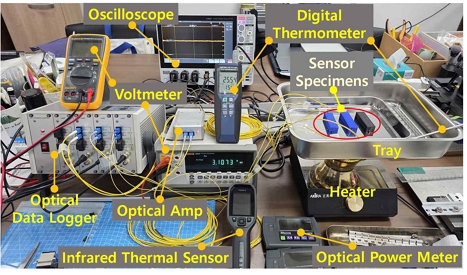
Photo of the experimental setup for thermal sensing measurements
3.3 Experiment results
Based on the experimental preparation described above, experiments were conducted as shown in Fig. 6. The experimental results are explained as follows. Each figure represents the average value of data obtained from at least five experiments. Moreover, since temperatures of approximately 50℃ are generally considered indicative of abnormal thermal conditions in electrical switchboards, the experimental range up to 80℃ was considered adequate for evaluating the proposed sensor for practical switchboard monitoring applications.
Fig. 7 to Fig. 9 show the output responses to temperature variation when rectangular silicone pads with different dimensions, thicknesses, and insertion lengths of the 5 μm core were used for the optical fiber sensors. First, Fig. 7 and Fig. 8 present the results obtained under the same pad dimensions and identical 5 μm core insertion lengths, but with different pad thicknesses. (2 mm and 5 mm) It was confirmed that the thinner pad specimen with a thickness of 2 mm produced a larger output response. However, relatively low sensitivity was observed in the low-temperature region during the initial stage of the experiment. Fig. 9 shows the response characteristics when the pad dimensions and thickness(5 mm) were identical to those in Fig. 8, while the insertion length of the 5 μm core was slightly increased to 4 mm. It was confirmed that relatively linear output characteristics could be obtained under this condition. In Fig. 10 and Fig. 11, three holes were machined in the silicone pad to investigate different response characteristics. These figures show the output responses to temperature variation when the dimensions of the silicone pad were 45 mm(L)×8 mm(W)×2 mm(T).
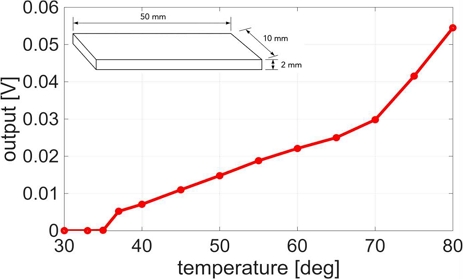
Sensor output characteristics according to temperature variation (Pad dimensions: 50 mm(L)×10 mm(W)×2 mm(T); 5 μm core insertion length: 3 mm)
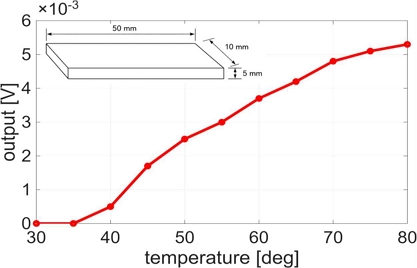
Sensor output characteristics according to temperature variation (Pad dimensions: 50 mm(L)×10 mm(W)×5 mm(T); 5 μm core insertion length: 3 mm)
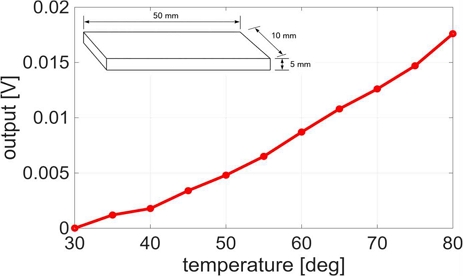
Sensor output characteristics according to temperature variation (Pad dimensions: 50 mm(L)×10 mm(W)×5 mm(T); 5 μm core insertion length: 4 mm)
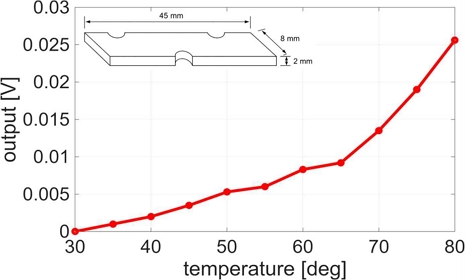
Sensor output characteristics according to temperature variation with three holes and in a free state (Pad dimensions: 45 mm(L)×8 mm(W)×2 mm(T); 5 μm core insertion length: 3 mm)
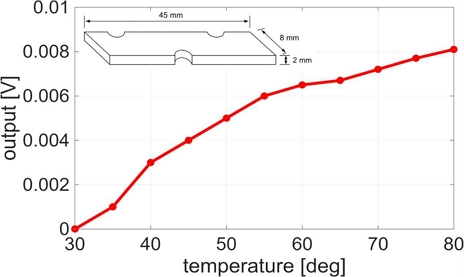
Sensor output characteristics according to temperature variation with three holes and fixation of both ends of the specimen (Pad dimensions: 45 mm(L)×8 mm(W)×2 mm(T); 5 μm core insertion length: 4 mm)
While the insertion lengths of the 5 μm core optical fiber were 3 mm in Fig. 8 and 4 mm in Fig. 9, respectively. Holes were introduced into the silicone pad based on the assumption that, as illustrated in Fig. 12, the perforated structure would allow the pad to bend and recover more easily in response to temperature variation.
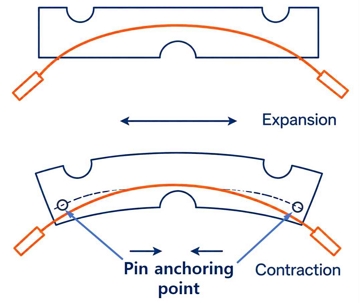
A strategy to improve bending characteristics by machining three holes and fixing both ends to enhance tensile and expansion properties
Nevertheless, consistent output characteristics could not be obtained. In particular, in Fig. 11, where the insertion length of the 5 μm optical fiber was 4 mm, a significant reduction in output response was observed. Therefore, further investigation is required regarding the optical fiber insertion method, fixation conditions, and structural improvement of the sensing configuration.
The nonlinear output characteristics are mainly attributed to the viscoelastic behavior of silicone and imperfect strain transfer between the silicone pad and optical fiber sensor. Silicone rubber exhibits creep, hysteresis, and stress relaxation under thermal loading, which can reduce sensing repeatability and sensitivity stability. In addition, variations in adhesive bonding may affect the transfer of thermally induced strain to the hetero-core sensing region.
4. Conclusions
In this study, a fiber-optic thermal monitoring module for early fire detection in electrical switchboards was developed and experimentally evaluated.
Since the primary objective is the prevention of fire accidents in electrical power systems, the use of conventional electrical sensors is not desirable due to electromagnetic interference and safety concerns.
Image-processing methods based on thermal imaging cameras have also been proposed; however, their applicability is limited because the internal space of switchboards is narrow and the available field of view is restricted.4)
Therefore, this study proposed an optical fiber-based temperature sensor module capable of detecting temperature variation using a single optical amplifier while connecting multiple sensor modules in series.
In particular, silicone-based pads with excellent thermal expansion and recovery characteristics were introduced as temperature responsive sensing elements. The relationship between temperature and output voltage was analyzed by varying the insertion length of the 5 μm core optical fiber installed on the silicone pads. The effects of pad dimensions and insertion length on the output characteristics were clearly evaluated, and an effective fabrication method for the proposed temperature sensor was established.
The proposed optical fiber sensor is immune to electromagnetic interference even in high voltage power systems and exhibits minimal signal distortion and information loss over long transmission distances.4,5)
Therefore, these advantages indicate strong applicability not only for switchboard fire monitoring systems but also for various condition monitoring applications requiring high reliability, practicality, and scalability.
Author contributions
Y. B. Kim and Y. W. Kitani; Conceptualization. E. J. Wi; Supervision. Y. Hagiwara; Formal analysis. E. J. Wi; Writing-original draft. Y. B. Kim and Y. W. Kitani; Writing-review & editing. Y. B. Kim and H. J. Kim; Methodology. H. J. Kim, Y. W. Kitani and H. Hagiwara; Investigation. Y. B. Kim and H. J. Kim; Funding acquisition. E. J. Wi; Software. E. J. Wi; Data curation. Y. B. Kim; Validation.
References
- Sensata Technologies, 2022, “Thermal Monitoring of High Current Electrical Circuits”, Application Note.
- Schneider Electric, 2022, “Thermal Monitoring to Identify Electrical Fire Risks”, Schneider Electric Blog.
- OMRON, 2024, “Thermal Panel Monitoring”, Product Brochure.
-
E. J. Wi, Y. W. Choi and Y. B. Kim, 2024, “Study on Development of a Fiber Optic Sensor for Fire Monitoring System in Switchboard”, Journal of Power System Engineering, 28(4), 53-59.
[https://doi.org/10.9726/kspse.2024.28.4.053]

-
P. K. Pramanik, R. Biswas, S. Mondal, S. Sarkar, D. Paul, S. Ray, S. K. Raj, P. Das, S. S. Mondal, S. Nandi, A. Sarkar and A. Acharyya, 2025, “Flexible Optical Bend-Sensor Based on TiO₂-Gel-Wax Nanocomposite Core and Silicone- Rubber Cladding”, Micro and Nanostructures, 209, Article 208437.
[https://doi.org/10.1016/j.micrna.2025.208437]
-
T. Yang, Y. Shui, C. Wei, L. Huang, C. Yang, G. Sun, J. Han, J. Xu, Z. Li and D. Liu, 2022, “Effect of Cyclic Straining with Various Rates on Stress Softening/Hysteresis and Structural Evolution of Filled Rubber: A Time-Resolved SANS Study”, Composites Part B: Engineering, 242, Article 110100.
[https://doi.org/10.1016/j.compositesb.2022.110100]
-
H. Xia, Y. Guan, Z. Yu, S. Cai, X. Wang, Z. Peng, S. Gao, Z. Huang, 2019, “Temperature Rise Test and Analysis of High Current Switchgear in Distribution System”, The Journal of Engineering, 2019(16), 2931-2934.
[https://doi.org/10.1049/joe.2018.8371]
-
M. A. Aguirre, M. Bierzychudek, D. N. Coppa and H. M. Laiz, 2025, “Virtual Experiment of Temperature Rise Test in High-Voltage Switchgear”, Measurement: Sensors, 38, Article 101494.
[https://doi.org/10.1016/j.measen.2024.101494]
-
J. Wang, R. Si, H. Wang, N. Zhou, C. Dai and Z. Zheng, 2025, “Study on the Influence of Contact Resistance on the Thermal Field of Cable Terminal Overheating Faults”, Lecture Notes in Electrical Engineering, 1410, 163-170.
[https://doi.org/10.1007/978-981-96-4800-9-17]
-
A. T. Moraleda, C. V. García, J. Z. Zaballa and J. Arrue, 2013, “A Temperature Sensor Based on a Polymer Optical Fiber Macro-Bend”, Sensors, 13(10), 13076-13089.
[https://doi.org/10.3390/s131013076]
-
X. Peng, Y. Cha, H. Zhang, Y. Li and J. Ye, 2017, “Light Intensity Modulation Temperature Sensor Based on U-Shaped Bent Single Mode Fiber”, Optik, 130, 813-817.
[https://doi.org/10.1016/j.ijleo.2016.11.003]
-
A. A. Romoro, K. N. Amouzou, D. Sengupta, C. A. Zimmermann, A. Richard-Denis, J.-M. M. Thiong, Y. Pedit, J.-M. Lina and B. Ung, 2023, “Optoelectronic Pressure Sensor Based on the Bending Loss of Plastic Optical Fibers Embedded in PDMS”, Sensors, 23(60), Article 3322.
[https://doi.org/10.3390/s23063322]
- H. Lee, J. Kim and S. Park, 2025, “Flexible Optical Bend-Sensor with Intensity-Modulated Readout Using LED and Photodiode”, Optics Communications, 585, Article 129012.
-
G. Yin, F. Zhang, B. Xu, J. He and Y. Wang, 2020, “Intensity-Modulated Bend Sensor by Using a Twin Core Fiber: Theoretical and Experimental Studies”, Optics Express, 28(10), 14850-14858.
[https://doi.org/10.1364/OE.390054]
- A. D. Kersey, W. W. Morey and M. Alexis, 2014, Fiber Optic Sensors: Fundamentals and Applications, SPIE Press, Chapter 3: “Intensity-Modulated Sensors”.
-
T. Cui, Y. Chao and J. W. Van Zee, 2013, “Thermal Stress Development of Liquid Silicone Rubber Seal under Temperature Cycling”, Polymer Testing, 32(7), 1246-1253.
[https://doi.org/10.1016/j.polymertesting.2013.07.009]
-
S. Zeng, W. Li, Y. Peng, Y. Zhang and G. Zhang, 2023, “Mechanism of Accelerated Deterioration of High-Temperature Vulcanized Silicone Rubber under Temperature Cycling”, Polymers, 15(15), Article 3210.
[https://doi.org/10.3390/polym15153210]
-
H. Liu and W. Li, 2020, “Creep Behavior of Silicone Rubber at Different Temperatures”, Chinese Journal of Mechanical Engineering, 44(4), 78-82.
[https://doi.org/10.11973/jxgccl202004015]